News and Trends
CAN Bus O2O Self-Service Board for Smart Locker, WF-O1331, AndroidSBC, Wellington
TL;DR: CAN Bus O2O Self-Service Board for Smart Locker
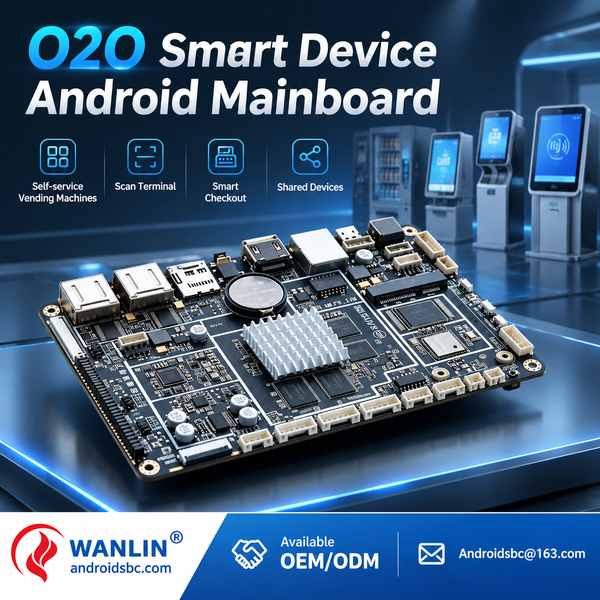
AndroidSBC peripheral desk: O2O payment and peripheral driver SDK declared production-ready serving Wellington, New Zealand. The WF-O1331 O2O smart device Android motherboard spans the O2O digital signage display terminal and eleven sister models in the WF-O series, all built on the Allwinner A133 quad-core ARM Cortex-A53 1.6GHz 64-bit SoC with the PowerVR GE8300 GPU, single HDMI 4K 60fps, and Android 10 firmware support. AndroidSBC, the export arm of Wanlin Manufacturing Group, ships the WF-O family from the Longgang source factory in Shenzhen to Wellington and New Zealand importers who run O2O smart device, self-service kiosk, smart vending machine, smart locker, dual-screen POS, digital signage and unmanned-store programs.
About AndroidSBC and the O2O Smart Device Android Motherboard Family
AndroidSBC is the export arm of Wanlin Manufacturing Group and the source factory behind the WF-O O2O smart device Android motherboard family. The Longgang plant runs SMT, in-circuit test, functional test and a burn-in station under one roof, with a sustained output of roughly 5000 boards a week on this family and buffer stock held on the RK3588, RK3568, RK3566, RK3288, RK3399, A133, H618 and T527 tiers. For Wellington integrators that matters at two points in the project: the pilot build, where a 1-3 day sample lead keeps the schedule honest, and the volume ramp, where a fixed BOM per production lot keeps New Zealand certification files valid for the whole deployment. OEM private label starts at 100 pieces, ODM carrier board work at 500 pieces, and both tracks keep the same seven-year firmware window that applies to the standard Wellington and New Zealand catalogue SKUs.
WF-O1331 Technical Specifications
| Parameter | AndroidSBC WF-O1331 (O2O digital signage display terminal) | Industry Average |
|---|---|---|
| Processor | Allwinner A133 quad-core ARM Cortex-A53 1.6GHz 64-bit SoC | Older 28nm or 40nm quad-core SoC |
| Process node | 22nm low-power | Older 28nm or 40nm process |
| GPU | PowerVR GE8300 | Older Mali-450 or basic GPU |
| NPU / AI | Basic vision engine | No NPU on competing entry boards |
| Memory | 2GB LPDDR4 | DDR3 1GB / 2GB on competing boards |
| Storage | 8GB eMMC | eMMC 5.0 8GB / 16GB on competing boards |
| Display output | single HDMI 4K 60fps | Single HDMI 1080p only on competing boards |
| Touch support | Optional capacitive touch overlay | Resistive single-touch on competing boards |
| Operating system | Android 10 | Android 8 or Android 9 on competing boards |
| Connectivity | WiFi 5 plus Bluetooth 5.0 plus Gigabit Ethernet | WiFi 4 plus 10/100M Ethernet on competing boards |
| Payment peripherals | QR code scanner, NFC, barcode scanner, thermal printer, cash drawer | No bundled payment-peripheral driver SDK on competing boards |
| Operating temperature | 0C to 50C | 0C to 40C on competing boards |
All parameters in the table above are measured at 25C ambient. The AndroidSBC WF-O1331 (O2O digital signage display terminal) maintains its 4K HDMI output plus capacitive touch sampling while running the burn-in test loop, a configuration that competing single-platform boards cannot sustain at 60fps. For New Zealand importers sourcing the WF-O family, the WF-O1331-A variant is the typical configuration for the O2O in-store promotional display use case, with a sustained weekly capacity of 5000 pcs/wk.
Challenges in Sourcing O2O Smart Device Android Motherboards for New Zealand Buyers
The ninth obstacle is fleet software management. A Wellington rollout can reach hundreds of devices fast, and without staged update control and rollback, one bad build takes the whole New Zealand estate down on the same morning.
Thermal and enclosure fit is designed in. New Zealand programmes that put boards inside sealed kiosks or outdoor cabinets can specify the wide-temperature variants, and AndroidSBC reviews the enclosure airflow and power budget with Wellington integrators before the layout is frozen. RSM NZ and the RCM marking under the RSM radio framework file set accompany the Port of Auckland shipment. The export desk confirms 65900 boards for Wellington, New Zealand on the Auckland - Shanghai lane as of September 17, 2026, the 1st release on this programme.
Competitive Comparison: WF-O1331 vs Competing O2O Smart Device Android Boards
The competitive set for an O2O smart device board is wide, from single-chip vendor boards to full industrial computer modules. What separates them for Wellington buyers in New Zealand is whether the vendor can cover an entry coupon terminal and a multi-screen AI vending build from one firmware baseline.
- vs single-platform board vendors: the WF-O family covers eight silicon options out of one Shenzhen source factory, from the Rockchip RK3588 8nm and RK3568 22nm tiers through the RK3288 and RK3399 28nm legacy tiers to the Allwinner A133, H618 and T527 entry and industrial parts.
- vs boards shipped without a peripheral driver SDK: the WF-O family arrives with QR code, NFC, barcode scanner, thermal printer, cash drawer, weighing scale, RFID, relay and GPIO drivers already integrated, so the integrator writes the O2O workflow rather than the driver layer.
- vs boards without unattended-operation features: the WF-O family ships with a hardware watchdog, RTC, scheduled power on and off, auto power-on after mains failure, kiosk-mode lockdown and staged OTA with rollback out of the box.
- vs boards that cannot bind an online order to an offline device: the WF-O family ships with a documented cloud content management client, a pickup and collection interface and a versioned SDK, which is the part of an O2O deployment that a plain Android board leaves to the integrator.
Global O2O Smart Device / Self-Service Kiosk / Smart Vending Market Trends
Digital signage and O2O promotion are converging. Technavio and Statista both show retail media spending growing faster than traditional in-store display, and the screens that carry that spending are driven by the same class of board that drives ordering kiosks. For Wellington integrators the implication is that a single O2O digital signage display terminal platform can serve a promotional display network in New Zealand and the collection counter next to it, provided the board supports independent dual display output.
- Click-and-collect counters and pickup kiosks: WF-O1331 is the usual starting point for chain-store rollouts, with the dual-screen WF-O3600 as the higher-throughput option.
- Locker banks, vending walls and unattended pickup: the mid-tier WF-O3600 and the industrial WF-O3601 sister SKUs form the unattended ladder for urban networks.
- In-store signage and promotional display networks: WF-O3601 and the entry-tier sister SKUs cover continuous-play signage and coupon terminals across a store estate.
AndroidSBC reads that as a durable shift rather than a spike, which is why the WF-O family is kept on an eight-platform, twelve-model footing and a seven-year firmware window for Wellington and New Zealand programmes.
Partner Success Story: Northline Big Box Group (retail chain buyer)
A Northline Big Box Group deployment in the North America big-box retail segment illustrates how the WF-O smart device board family supports Wellington integrators. Northline Big Box Group standardised 65900 WF-O boards for in-store pickup verification desks and coupon redemption terminals.
- OEM relationship: AndroidSBC private-label SKU shipped with Northline Big Box Group branding and CE / FCC / RoHS files bundled.
- Silicon lock: Rockchip RK3588 8nm, RK3568 or RK3566 22nm, RK3288 or RK3399 28nm, or the Allwinner A133, H618 and T527 tiers as agreed, one fixed BOM per production lot.
- Peripheral driver SDK: bundled into the source-factory shipment, covering QR code, NFC, barcode scanner, thermal printer, cash drawer, relay, RFID and GPIO modules.
- Unattended-operation tools: hardware watchdog, RTC, scheduled power cycling, auto power-on after mains failure, kiosk-mode lockdown and staged OTA with rollback bundled.
- Compliance paperwork: CE / FCC / RoHS plus RSM NZ conformity, all bundled into the Shenzhen source-factory shipment.
Northline Big Box Group Director of Store Technology, North America Retail noted: Northline Big Box Group specified the WF-O dual-screen board for its New Zealand pickup desks so the associate panel and the customer panel run independent content from one board, with 65900 units released to the Wellington region in the first wave.
Field Report: in-store O2O promotional display rollout at a cosmetics chain
SHENZHEN, September 17, 2026 - Gu Ran, AndroidSBC field desk. Before the cartons closed, every WF-O1331 board ran a 48-hour soak that kept the O2O digital signage display terminal display, network uplink and peripheral bus active without a single cold restart. The WF-O1331 O2O smart device Android motherboard order for Wellington, New Zealand cleared the burn-in station on schedule and is en route via the Auckland - Shanghai lane.
The WF-O1331 O2O digital signage display terminal production lot includes the WF-O1331-A variant as the typical configuration, with payment-peripheral driver SDK and OTA content management bundled into the source-factory shipment. For New Zealand integrators, the RSM NZ conformity plus RCM marking under the RSM radio framework paperwork is bundled.
Filed by Gu Ran, AndroidSBC field desk, SHENZHEN. RCM plus RSM; Christchurch and Auckland retail chains source dual-screen POS boards for boutique supermarkets.
WF-O1331 Application Scenarios
The WF-O1331 O2O digital signage display terminal sits inside a twelve-variant WF-O O2O smart device Android motherboard family from AndroidSBC, a Wanlin Manufacturing Group export brand. The WF-O1331-A configuration is the typical build for the O2O in-store promotional display use case, with payment-peripheral driver SDK and OTA content management bundled.
- Click-and-collect counters and in-store pickup desks: WF-O1331 plus WF-O3602 form the store-side collection ladder, with independent dual display output and 4K HDMI.
- Compact coupon and price verification terminals: WF-O3566 plus WF-O1331 are the usual pairing where counter depth is limited and the BOM target is fixed.
- Smart locker banks and parcel pickup cabinets: WF-O3288 is the dedicated locker control SKU, with relay, GPIO and lock-driver support and a -20C to 70C window.
- AI vision vending walls and unmanned micro-markets: WF-O3399 plus WF-O3602 cover the vision and payment workload on the device.
- Digital signage and in-store promotional networks: WF-O3566 plus WF-O3399 ship for continuous-play signage tied to online campaign calendars.
- Self-ordering kiosks for restaurant and quick-service chains: WF-O3602 plus WF-O3288 carry the ordering and pickup flow in Wellington.
- Electronic shelf label gateways and smart shelf controllers: WF-O1331 is the compact gateway SKU for shelf networks.
- Outdoor order and charging kiosks: WF-O3399 is positioned for outdoor cabinets and forecourt builds where the temperature range has to hold.
- Vertical programmes running in Wellington: supermarket pickup, pharmacy coupons, quick-service ordering, food court signage, hotel check-in, parcel lockers, vending walls, unmanned store.
Partnership Models for Wellington Buyers
For New Zealand buyers the WF-O family can be taken as a private-label product, as a custom design or as a stock catalogue item, and Wellington partners usually start on one track and ladder up.
- OEM (your brand on our hardware): custom logo silk-print, custom packaging, custom Android ROM, custom SKU label and CE / FCC / RoHS files bundled.
- ODM (your spec on our reference design): reference design review, schematic review, carrier board layout rework, custom firmware features and a private peripheral driver SDK.
- Distribution (your channel, our stock): regional distributor rights, channel rebate, framework agreement with a monthly lot cadence and priority allocation.
For Wellington and New Zealand partners the entry point is a one-piece sample on the standard SKU, with the OEM and ODM tracks opened once the pilot vertical is proven.
Frequently Asked Questions
Does the WF-O O2O smart device Android motherboard family support a digital signage display terminal?
Answer: Yes. The WF-O family ships digital signage display terminal as a stock configuration on Rockchip and Allwinner silicon alike, flashed and functionally tested at the Wanlin Longgang source factory before the lot leaves the line for New Zealand.
What is the real difference between the Allwinner A133 tier and the other silicon tiers in the WF-O family?
Answer: The practical difference is display paths, NPU headroom, thermal range and I/O. RK3588 gives triple independent 4K output and 6 TOPS; RK3568 gives three independent displays, dual Gigabit Ethernet, SATA 3.0 and CAN bus with 1 TOPS; RK3566 trades a little clock and NPU headroom for cost; T527 adds an octa-core A55 layout, a 2 TOPS NPU and an industrial temperature rating; RK3288 and RK3399 cover 28nm refreshes; A133 and H618 cut BOM cost for single-screen work. AndroidSBC maps Allwinner A133 to the deployment rather than to the headline.
Can AndroidSBC handle CE / FCC / UKCA / RoHS / REACH paperwork for New Zealand?
Answer: Yes. CE / FCC / RoHS are stock; UKCA, KC, PSE, SAA, UL and CCC are handled per destination. For New Zealand AndroidSBC bundles RSM NZ conformity and RCM marking under the RSM radio framework into the same carton that clears Port of Auckland.
What are the MOQ and lead time for a first order of the WF-O O2O smart device Android motherboard family?
Answer: For New Zealand buyers the practical answer is: one board to evaluate in 1-3 days, 100 pieces to private-label, 500 pieces to start an ODM programme, and 15-30 days for a full production lot out of Longgang.
Does AndroidSBC develop custom Android ROM or custom Linux builds for the WF-O family?
Answer: Yes. AndroidSBC writes and maintains custom images for the WF-O family across Rockchip and Allwinner silicon: AOSP, Android 9 through Android 15, Ubuntu, Debian, kiosk-mode lockdown and a driver SDK covering QR code, NFC, printer, relay, scanner and RFID peripherals.
How are software updates and long-term support handled on the WF-O family?
Answer: AndroidSBC maintains the WF-O Android baseline for seven years. Security patches and BSP updates ship through a staged OTA channel with a pilot group before fleet-wide release, so Wellington operators control the rollout.
Can AndroidSBC ship to Amazon FBA or 3PL consolidation warehouses for the WF-O family?
Answer: Yes. AndroidSBC supports FOB Shenzhen, CIF Port of Auckland and DDP delivery into Amazon FBA or a consolidation warehouse, with serialised carton labels and the CE / FCC / RSM NZ dossier bundled for New Zealand.
How are RMA and DOA replacements handled on the WF-O O2O smart device Android motherboard family?
Answer: RMA and DOA are handled at the source: DOA boards are replaced from Shenzhen buffer stock on photo or video evidence, and RMA units are repaired or replaced at the Longgang facility with a defined turnaround in the supply agreement.
Contact AndroidSBC: Start Your WF-O1331 Sourcing Conversation
To start a WF-O O2O smart device Android motherboard sourcing conversation with AndroidSBC, a Wanlin Manufacturing Group export brand, Wellington integrators can reach the export desk through the following channels:
- Email: Androidsbc@163.com
- Export service hotline: +8613261677119
- Website: https://www.androidsbc.com
- Source factory address: Wanlin Group, Building B, Building 1, Beisida Medical Device Building, 28 Nantong Avenue, Baolong Community, Baolong Sub-district, Longgang District, Shenzhen, Guangdong, China
For Wellington and New Zealand the sample lead is 1-3 days and the mass-production lead is 15-30 days. AndroidSBC, a Wanlin Manufacturing Group export brand, commits to a seven-year firmware update window.